A Deep Dive Into India’s Worst Aviation Breakdown
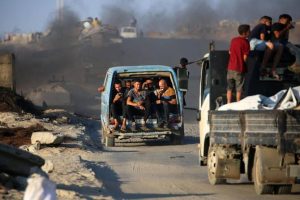
Last week, Manjuri carried her husband’s coffin from one town to another across India’s remote northeast, desperately trying to catch a flight that would take her hundreds of miles away—towards Kolkata—for his final rites. But the journey that was already emotionally crushing became almost unbearable when delays by IndiGo, the country’s largest airline, left her stranded for hours before the flight was ultimately cancelled. The widow—exhausted, grieving, and helpless—was one of hundreds of thousands whose plans fell apart as IndiGo plunged into an unprecedented operational meltdown.
What began as scattered delays rapidly evolved into a full-blown national crisis. On 5 December, more than 1,000 IndiGo flights were abruptly cancelled—an astonishing number for any major airline, let alone one that controls 60% of India’s domestic aviation market. Weddings were missed, funerals postponed, exams abandoned, and business meetings dissolved into frustration.
India, one of the world’s fastest-growing aviation markets, suddenly found itself staring at a sobering reality: the failings of a single airline had the power to disrupt travel plans for an entire nation.
This is the inside story of what went wrong—how crew-rest regulations, corporate decisions, financial pressures, and organisational oversight combined to push IndiGo into the worst aviation crisis in its history.
A Catastrophic Week for India’s Biggest Airline
IndiGo, known for its punctuality to the point of obsession and a no-frills formula that made it India’s most trusted domestic brand, suddenly found itself cancelling over half its daily operations. Images of passengers sleeping on airport floors spread across social media, amplifying public anger.
Airports in Delhi, Mumbai, Kolkata, Guwahati, Hyderabad, and Bengaluru witnessed scenes rarely seen outside monsoon disruptions or air traffic control failures:
Children crying from exhaustion,
elderly passengers stranded with no help,
families begging airline staff for updates,
students fearing missed university deadlines.
For many, it was a déjà vu moment recalling earlier airline failures such as Kingfisher and Jet Airways—but this time, the shock was sharper because IndiGo was supposed to be the stable one, the invincible one, the untouchable king of India’s skies.
The Regulatory Spark: What Changed?
At the centre of IndiGo’s crisis was a new set of crew-duty regulations—meant to improve safety by ensuring pilots and cabin crew are well-rested. These changes had been under discussion for nearly two years, and airlines were supposed to implement them in two phases:
Phase 1: June 2024
Phase 2: November 2024
The revised rules included:
An increase in weekly rest from 36 to 48 hours for pilots
A reduction in night landings from 6 to 2 per week
Stricter limits on maximum duty hours
Tighter monitoring of cumulative fatigue
These adjustments were responses to years of increasing pilot burnout, especially as Indian carriers aggressively expanded domestic and international routes while operating on shoestring budgets.
But while rival carriers like Air India complied, IndiGo admitted it could not fully adopt the changes.
The consequences were immediate and devastating.
When the new rules kicked in, IndiGo found itself short of legally rested pilots. Aircraft sat idle on tarmacs across the country, unable to fly. A domino effect followed: as flights were cancelled, remaining schedules collapsed due to crew displacement.
How Did IndiGo Get Here? Planning Failure or Cost Saving Attempt?
Aviation analysts were quick to ask a blunt question:
How did India’s largest airline—known for its meticulous planning—allow this to happen?
Mark Martin, a well-known aviation expert, told the BBC:
“They had months of notice. All other airlines complied. Why did IndiGo fail?
Implementing these rules would have required hiring hundreds of additional pilots, increasing costs. Did they simply avoid the expenditure?”
Indeed, IndiGo’s business model is famously lean. Every rupee saved is a rupee earned, and the airline has historically excelled at cost discipline. However, several insiders suggest that the same cost-minimisation strategy may have backfired spectacularly.
One senior IndiGo pilot, speaking anonymously, said:
“Fatigue in aviation is a silent killer. Some industries can push overtime—this one cannot. When pilots are exhausted, safety is compromised long before anyone notices.”
Pilots interviewed across multiple Indian carriers say that IndiGo crews have been reporting fatigue at higher rates in recent years, as the airline expanded rapidly into foreign markets and smaller Indian towns.
The Human Cost: Stories From Stranded Passengers
Beyond operational charts and regulatory discussions, the real impact was borne by passengers.
Funerals Missed
Manjuri’s heart-breaking story hit national headlines, not just because of the tragedy she endured but because it symbolised the human consequences of systemic failures.
Another family in Hyderabad missed their father’s last rites in Chennai because their flight was cancelled minutes before boarding.
Weddings Postponed
Multiple families complained that wedding functions had to be rescheduled—or in some cases, conducted without key members—due to IndiGo mishaps.
Students in Crisis
University students heading for critical exams or scholarship interviews found themselves stuck for days.
Medical Passengers
Patients traveling for surgery or specialist appointments found themselves abandoned without alternatives.
IndiGo issued apologies, citing “unforeseen operational challenges”, but for thousands of Indians, the damage was irreversible.
Aviation Monopolies and Their Risks
Industry veterans point out that IndiGo’s current troubles are tied to its unmatched dominance.
GR Gopinath—founder of Air Deccan, the airline that once brought affordable aviation to India—wrote:
“With 60% market share, IndiGo is effectively a monopoly. And monopolies often stop listening.”
Over the last 15 years, Indian skies have witnessed multiple airline collapses:
Kingfisher Airlines (grounded in 2012)
Jet Airways (ceased operations in 2019)
GoAir (suspended operations in 2023)
With rivals falling away, IndiGo filled the vacuum, growing into a giant that flew over 100 million passengers annually.
But monopoly has its own pitfalls. And industry experts now believe that IndiGo may have grown too big, too quickly.
A System Built for Efficiency, Not Resilience
Moody’s, the financial ratings agency, issued a stark warning:
“IndiGo’s lean cost structure is efficient in stable conditions but lacks resilience during regulatory or operational disruptions.”
The agency noted that the crew-rest rule changes required more staffing buffers—buffers IndiGo never built.
Thus, when the new rules came into effect, the airline experienced what Moody’s described as a “system-wide reboot”, forcing the cancellation of 1,600 flights on 5 December alone.
The financial implications are severe:
Massive refunds
Compensation claims
Higher staffing costs
Lost revenue
Regulatory penalties
Investor panic
IndiGo’s share price slid sharply on the Mumbai stock exchange as investor confidence eroded.
Regulator Steps In: Warnings, Notices, and Political PressureIndia’s aviation minister addressed Parliament, issuing a stern warning: “very strict action” awaited the airline.
The DGCA, India’s aviation regulator, sent IndiGo a show-cause notice, citing:
“Significant lapses”
“Poor oversight”
“Inadequate planning”
“Failure to comply with pilot fatigue norms”
The DGCA also reportedly asked IndiGo to cut its schedule by 5% until it could prove operational stability.
Aviation expert Ameya Joshi called this a critial moment:
“This is a golden chance for the regulator to make an example out of IndiGo. India is watching.”
Pilots’ Association Raises Red Flag: “Safety Compromised”
While IndiGo negotiated with regulators, its pilots opened a new front.
The Airline Pilots Association of India (ALPAI) wrote to the regulator:
“Granting IndiGo exemption from fatigue rules has gravely compromised the safety of the flying public.”
The letter suggested that the crisis was not merely an operational glitch but symptomatic of a deeper structural neglect of crew welfare.
IndiGo, when asked about these accusations, declined to comment.
Other Airlines Ready to Profit From IndiGo’s Fall
Competitors were quick to seize the opportunity presented by IndiGo’s chaos.
Air India announced additional flights
SpiceJet opened temporary new routes
Akasa Air promoted fare deals targeting stranded passengers
“These airlines will go after IndiGo’s customers,” said expert Mark Martin.
IndiGo’s market lead was always its biggest strength—but now, it risks becoming its biggest vulnerability.
Can IndiGo Recover? Experts Say It May Take Years
Aviation analysts describe three major challenges IndiGo now faces:
- Rebuilding Reputation
Trust, once broken, is hard to restore.
Millions of Indian passengers who swore by IndiGo’s reliability now feel betrayed. - Rebuilding Operational Capacity
IndiGo’s recovery timeline remains unclear. Even after receiving temporary regulatory relief, operations have stabilised only partially. - Rebuilding Its Workforce
Pilot morale is at an all-time low. Fatigue debates have escalated. The airline may struggle to hire new pilots.
Moody’s expects a long-term impact on:
Finances
Passenger loyalty
Operational stability
Brand value
What This Crisis Means for India’s Aviation Future
IndiGo’s breakdown has raised larger questions about India’s aviation system:
A. Is India Overdependent on One Airline?
With IndiGo controlling 60% of the market, the collapse of even a fraction of its flights affects the entire aviation ecosystem.
B. Are New Fatigue Rules Enough?
Pilot fatigue remains one of the biggest global safety concerns.
India’s regulatory overhaul aligns with international norms—but enforcement remains a challenge.
C. Should Airlines Be Required to Maintain Crew Buffers?
Most major global airlines maintain excess pilot capacity to absorb shocks.
Indian carriers, operating on minimal margins, often skip such buffers.
D. Will This Lead to Ticket Price Surges?
Possibly. Hiring more pilots, training them, adjusting schedules, and reducing operational efficiency may push fares upward.
Conclusion: A Crisis of Confidence, A Test of Accountability
Manjuri’s devastated journey is not an isolated story—it is the human face of a much bigger disaster.
IndiGo’s crisis has exposed:
Fragile operational planning
Regulatory blind spots
Underinvestment in pilot welfare
The risks of market domination
The dangerous intersection of cost-cutting and safety
India’s aviation ecosystem—once hailed as one of the world’s fastest-growing—now faces a reckoning.
Whether IndiGo emerges from this turmoil stronger or weaker will depend on:
Transparent corrective actions
Honest engagement with regulators
Financial discipline balanced with crew welfare
Long-term planning instead of short-term savings
But one thing is already clear:
The airline that once symbolised reliability must now fight to regain the trust of the nation.
If you want, I can also prepare:
✓ A shorter 1,000-word version
✓ A front-page summary
✓ A headline package
✓ A YouTube script version
Just tell me!
You said:
Write 3 illustrative colofull text to image prompts in reference to above.
ChatGPT said:
Here are 3 colourful, illustrative text-to-image prompts based on the article above.
Each prompt is crafted for newspaper-style, realistic storytelling visuals:
- Airport Chaos After IndiGo Cancellations
A crowded Indian airport terminal filled with stranded passengers, colourful bags and suitcases scattered on the floor, exhausted families sitting on chairs and sleeping on the ground, digital flight boards displaying dozens of cancelled IndiGo flights in bright red, staff trying to manage large frustrated crowds, vivid lighting, photorealistic style, high detail, dramatic colours, emotionally intense atmosphere. - Manjuri Standing Beside Her Husband’s Coffin
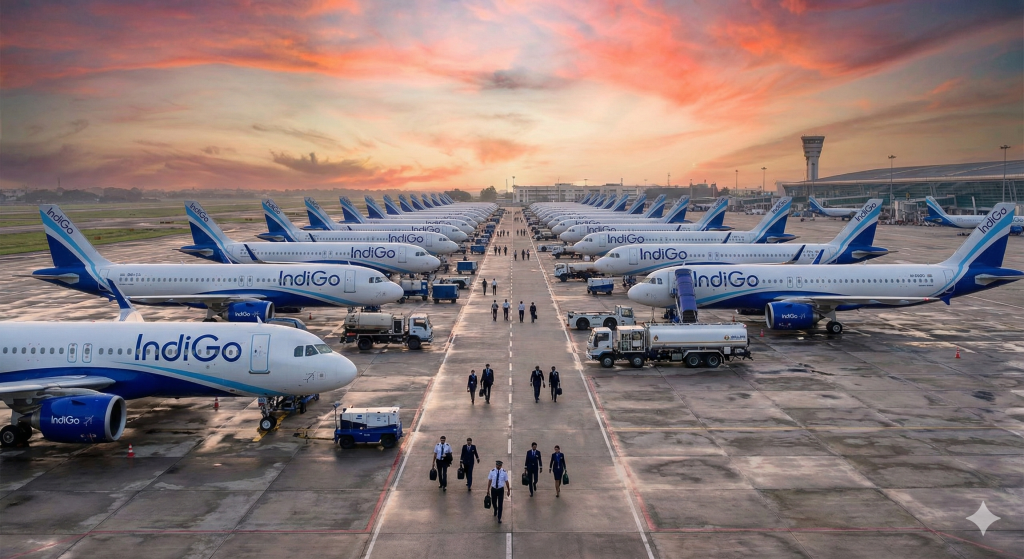
A grieving woman in traditional Assamese attire standing beside a wooden coffin at a small rural airport, holding travel documents, surrounded by dim ambient lighting, rain-soaked tarmac, an IndiGo aircraft in the background, expressive emotional depth, soft colours contrasting with the sorrowful mood, cinematic realism, highly detailed textures, evocative storytelling composition. - IndiGo Aircraft Grounded on Tarmac
Dozens of IndiGo planes lined up on an airport tarmac at sunrise, all grounded, pilots and crew walking away looking tired, vibrant blue and white aircraft colours shining under dramatic sky, maintenance vehicles parked idle, sense of paralysis and stillness, ultra-detailed photorealistic rendering, strong shadows, bold and colourful aviation scene capturing the scale of the crisis.