India at 80:A New Chapter of Partnership, Progress and Shared Promise with Saudi Arabia

As India celebrates the 80th anniversary of its Independence, the occasion offers far more than an opportunity to remember the historic achievement of August 15, 1947. It is a moment to reflect on an extraordinary national journey — from colonial rule to self-government, from a newly independent nation confronting immense challenges to one of the world’s most consequential economies, and from a country finding its place in the international system to a trusted partner in addressing some of the defining challenges of the 21st century.
For millions of Indians, Independence Day remains deeply emotional. The national flag flying above government buildings, schools, institutions and homes evokes the sacrifices of generations who struggled for freedom. The day recalls the courage of those who challenged colonial rule and the determination of leaders and ordinary citizens who believed that India could govern itself and build a democratic future despite its enormous diversity and daunting social and economic challenges.
Eighty years later, that journey continues.
India today stands at a significant point in its history. Its demographic strength, expanding economy, technological capabilities, infrastructure transformation and global partnerships have created opportunities that could reshape the country’s future. At the centre of this transformation is the aspiration of more than 1.4 billion people and the national vision of building a developed India by 2047, the centenary of Independence.
This ambition is increasingly reflected in India’s engagement with the wider world. The country seeks partnerships based on mutual respect, trust, shared interests and a commitment to global welfare. One of the most important relationships in this evolving international landscape is India’s strategic partnership with the Kingdom of Saudi Arabia.
For India, Saudi Arabia is much more than an energy supplier or trading partner. For Saudi Arabia, India represents not only a major economic power and a vast market but also a country with deep human, cultural and commercial connections to the Kingdom.
The relationship between the two countries has grown steadily in recent decades, developing into a broad-based strategic partnership covering energy, investment, defense, security, technology, infrastructure, healthcare, education, culture and tourism.
At the heart of this relationship, however, remain people.
More than 2.7 million Indians live and work in Saudi Arabia. They form one of the largest Indian communities abroad and constitute a living human bridge between India and the Kingdom. Their contribution to Saudi Arabia’s economic and social development, while maintaining strong emotional connections with their homeland, has given the bilateral relationship a unique people-to-people dimension.
As India enters its 80th year of Independence, the country’s relationship with Saudi Arabia therefore offers an important illustration of how historic connections can evolve into modern strategic partnerships.
Independence Day: Remembering the Journey
Every August 15, India remembers the moment in 1947 when colonial rule came to an end and the country emerged as an independent nation.
Independence was not simply the transfer of political authority. It represented the fulfilment of a long and difficult struggle involving countless individuals whose names never entered history books. Freedom fighters, political leaders, social reformers, students, workers, farmers and ordinary citizens contributed in different ways to the movement for independence.
The achievement came at enormous human cost and against a background of political uncertainty and social upheaval. Yet the newly independent country chose a democratic path.
That decision has remained one of the defining characteristics of modern India.
The world’s largest democracy emerged from an exceptionally diverse society, comprising different languages, religions, cultures, traditions and regional identities. The task of maintaining national unity while preserving diversity was immense. Yet India’s democratic institutions gradually developed and strengthened, providing a framework within which competing ideas and interests could coexist.
Independence Day consequently carries two messages.
The first is remembrance — of those who sacrificed their lives and freedom so that future generations could live in a sovereign country.
The second is responsibility — the responsibility to ensure that the freedoms gained in 1947 translate into opportunity, dignity, security and prosperity for generations to come.
That responsibility is particularly important as India looks toward 2047.
The centenary of Independence has become a powerful national horizon, with the vision of “Viksit Bharat 2047” seeking to transform India into a fully developed nation by the time it completes 100 years as an independent country.
The journey from 1947 to 2047 therefore represents not merely a historical timeline but an intergenerational project.
A Civilization Looking Toward the Future
India’s modern transformation cannot be separated from its civilizational inheritance.
For millennia, the Indian subcontinent has been home to rich traditions of philosophy, science, mathematics, literature, art, commerce and cultural exchange. Indian civilization has repeatedly absorbed outside influences while retaining its own distinctive character.
This legacy contributes to the country’s international identity today.
India’s global engagement is increasingly shaped by the belief that economic growth and technological progress must coexist with cultural confidence and international responsibility. The country seeks to combine the dynamism of a modern economy with the values derived from its long historical experience.
Its diversity is also an important source of strength.
India’s many languages, cuisines, artistic traditions, festivals and regional cultures contribute to an extraordinary cultural landscape. Millions of Indians living abroad carry aspects of this diversity with them, creating connections between India and communities around the world.
Saudi Arabia is one of the places where this human connection is particularly visible.
Indian professionals, entrepreneurs, engineers, doctors, teachers, technicians, skilled workers and businesspeople have contributed to the development of the Kingdom for decades. Their presence has created familiarity and goodwill between the two societies.
The relationship therefore extends beyond government-to-government diplomacy.
It is also a relationship between families, businesses, institutions, professionals and communities.
India’s Economic Transformation
India’s rise as one of the world’s major economies is among the most significant developments of the contemporary global economy.
The country’s growth has been supported by several interconnected forces: expanding domestic consumption, entrepreneurship, digital transformation, manufacturing, infrastructure development, services, investment and a large and increasingly skilled workforce.
India’s young population provides both an opportunity and a responsibility.
A large youth population can become an extraordinary economic asset when supported by education, skills, employment opportunities and innovation. India’s policymakers therefore face the challenge of ensuring that economic expansion generates opportunities across regions and social groups.
The aspiration of India’s youth is closely connected to the vision of Viksit Bharat 2047.
A developed India cannot be measured only by the size of its economy. It must also be reflected in modern infrastructure, accessible healthcare, quality education, technological capability, productive employment, environmental sustainability and improved living standards.
The transformation already underway in several sectors demonstrates the scale of this ambition.
Building the Infrastructure of a Modern India
Infrastructure is one of the most visible symbols of India’s transformation.
Roads, highways, railways, airports, ports and logistics networks are expanding at a pace intended to support both economic growth and greater connectivity between India’s cities, towns and rural areas.
National highway construction now proceeds at close to 34 kilometres per day, while railway track laying exceeds eight kilometres daily.
These figures represent more than construction statistics.
Every new highway can reduce travel time, connect producers with markets and improve access to education and healthcare. Every new railway line can strengthen regional connectivity and create opportunities for trade and mobility.
India has also emerged as the world’s third-largest domestic aviation market. The expansion of aviation reflects a broader change in the country’s economy, with more people travelling for employment, education, tourism and business.
For Saudi Arabia, this infrastructure transformation creates opportunities for cooperation.
The Kingdom’s Vision 2030 has placed major emphasis on infrastructure, logistics, tourism, urban development and economic diversification. India’s expertise in digital infrastructure, construction, transportation and large-scale project execution can complement Saudi Arabia’s ambitions.
Similarly, Saudi investment and capital can support India’s continuing infrastructure expansion.
The potential is therefore not limited to bilateral trade. It includes partnerships in infrastructure development, logistics, supply chains and connectivity.
The Energy Partnership
Energy has traditionally been one of the strongest pillars of India-Saudi relations.
India is one of the world’s largest energy-consuming economies, while Saudi Arabia is a major global energy producer. This creates a natural economic relationship based on mutual dependence.
Saudi Arabia’s role in ensuring reliable supplies of energy and fertilizers is strategically important for India.
At the same time, India’s energy future is changing.
The country has set an ambitious goal of reaching 500 gigawatts of renewable energy capacity by 2030. Beyond renewable energy, India also intends to significantly expand nuclear power, with an aspiration of reaching 100 GW of nuclear capacity by 2047.
The passage of the landmark SHANTI Act is expected to create greater scope for private-sector participation in India’s nuclear sector, adding another dimension to the country’s long-term energy strategy.
The energy relationship between India and Saudi Arabia can consequently evolve from a traditional supplier-buyer model toward a broader partnership.
Renewable energy, green hydrogen, energy storage, advanced technologies and low-carbon industrial development could become increasingly important areas of cooperation.
Saudi Arabia has significant ambitions in renewable energy and hydrogen, while India has growing capabilities in solar power, digital systems, manufacturing and energy technologies.
The combination could create opportunities for joint investment, research and industrial partnerships.
Digital India and the Fintech Revolution
Perhaps nowhere is India’s transformation more visible than in digital technology.
India has developed a vast digital public infrastructure ecosystem that has changed the way millions of people access financial services and conduct everyday transactions.
In financial technology, India has become a global leader, handling nearly half of real-time digital payment transactions worldwide.
The scale of India’s digital payment ecosystem demonstrates how technology can be used to address challenges of access, affordability and convenience.
The significance extends beyond payments.
India’s experience with digital public infrastructure, identity systems, financial inclusion and technology-enabled governance has attracted international interest.
Saudi Arabia’s own digital transformation under Vision 2030 creates substantial potential for cooperation.
Both countries are investing heavily in smart infrastructure, digital services, artificial intelligence and emerging technologies. Their governments and private sectors can share experiences and develop commercial partnerships that go beyond traditional economic exchanges.
The future of India-Saudi economic relations is therefore likely to become increasingly digital.
Artificial Intelligence, Semiconductors and Quantum Technology
The next phase of global economic competition will be shaped by advanced technologies.
Artificial intelligence, semiconductors and quantum computing are already influencing national strategies, industrial policies and defense planning.
India has invested more than $10 billion across its artificial intelligence, quantum computing and semiconductor missions, demonstrating the importance the country places on technological self-reliance and advanced research.
The development of domestic technological capabilities is particularly significant because global supply chains are becoming more strategic.
Semiconductors, computing infrastructure, AI systems and advanced manufacturing technologies are no longer viewed solely as commercial assets. They are increasingly connected with national security, economic resilience and strategic autonomy.
India and Saudi Arabia can play complementary roles in this emerging technological landscape.
India possesses a large technology workforce, a strong software ecosystem and extensive experience in digital public infrastructure. Saudi Arabia, meanwhile, has significant financial resources, ambitious diversification plans and an increasingly sophisticated technology ecosystem.
Cooperation in AI research, digital infrastructure, cloud technologies, cybersecurity, semiconductor manufacturing and advanced industrial applications could become one of the most promising areas of the bilateral partnership.
India’s New Space Economy
India’s space programme has traditionally been associated with the state-led achievements of its national space institutions.
Today, however, the country’s space sector is undergoing a major transformation.
Private enterprise has entered the industry, and more than 400 startups are now part of India’s growing space ecosystem. One of these startups has already achieved unicorn status.
The opening of the space industry to private companies has created opportunities in satellite technology, launch services, communications, Earth observation, navigation and space-based applications.
For Saudi Arabia, space represents another emerging area of cooperation.
The Kingdom has increasingly shown interest in advanced science and technology as part of its economic diversification agenda. Cooperation with India could involve satellite applications, remote sensing, climate monitoring, telecommunications, scientific research and commercial space ventures.
Space cooperation also has applications in agriculture, disaster management, environmental monitoring and navigation.
The emerging partnership therefore has the potential to move beyond traditional sectors and enter highly advanced areas of science and technology.
A Growing Defense and Security Relationship
Defense and security have become increasingly important components of India-Saudi relations.
The strategic environment surrounding the Gulf and wider West Asian region has underscored the importance of maritime security, freedom of navigation, counterterrorism, intelligence cooperation and protection of critical infrastructure.
India has strong strategic interests in the uninterrupted movement of trade and energy through vital maritime routes.
Saudi Arabia, situated at the crossroads of major energy and commercial corridors, has similar interests in regional stability and secure transportation networks.
The two countries therefore share important common ground.
India’s growing defense manufacturing capabilities and Saudi Arabia’s ambitions to strengthen domestic defense industries could create opportunities for cooperation in defense technology, equipment, training and industrial partnerships.
India’s defense technology is also receiving growing international interest, creating opportunities for the country to expand its role as a supplier and technology partner.
Such cooperation, however, is best understood as part of a wider strategic relationship based on stability, mutual security and the protection of economic interests.
The Strategic Partnership Council
Political relations between India and Saudi Arabia have strengthened considerably in recent decades.
The visits of Crown Prince Mohammed bin Salman to India in 2023 and Prime Minister Narendra Modi to Saudi Arabia in 2025 represented important milestones in the relationship.
High-level political engagement has helped establish mechanisms for regular consultation and cooperation.
The Strategic Partnership Council has been expanded with new ministerial committees dealing with defense cooperation and tourism and cultural cooperation, complementing existing structures focused on political and economic cooperation.
These mechanisms matter because a modern strategic partnership requires regular institutional engagement.
Relations between India and Saudi Arabia now extend across multiple ministries and sectors. Foreign ministers, national security advisers, senior officials and parliamentarians regularly engage on bilateral, regional and international issues.
This institutional architecture provides stability and continuity.
It also allows the two countries to identify emerging areas of cooperation before they become major economic or strategic priorities.
Trade: A Partnership of Complementary Economies
Economic relations form one of the strongest foundations of the India-Saudi partnership.
Bilateral trade has crossed $41 billion.
India is Saudi Arabia’s third-largest trading partner, while Saudi Arabia is India’s fifth-largest trading partner.
These figures reflect the complementary nature of the two economies.
India offers a huge consumer market, a large manufacturing and services base, technological expertise and a substantial pool of skilled professionals.
Saudi Arabia offers energy resources, investment capital, strategic geographic access and an ambitious economic diversification programme.
The relationship is therefore not simply based on the exchange of goods.
It increasingly involves investment, technology, services and joint ventures.
As Saudi Arabia implements Vision 2030, Indian businesses are finding new opportunities in the Kingdom.
The number of Indian companies registered in Saudi Arabia has increased dramatically, rising from about 500 in 2020 to more than 6,000 today.
That expansion demonstrates the growing confidence of Indian businesses in the Saudi market.
It also reflects the Kingdom’s changing economic landscape.
Saudi Investment and India’s Opportunity
Saudi investment in India is another important pillar of the relationship.
The total Saudi investment in India, including investments by the Public Investment Fund, Saudi companies and the Saudi-backed Vision Fund, is estimated at about $10 billion.
The scale of investment reflects growing confidence in India’s economic prospects.
For India, foreign investment is important not only because it brings capital but also because it can create jobs, strengthen supply chains, introduce new technologies and expand international business networks.
For Saudi Arabia, investing in India provides access to one of the world’s largest and fastest-growing major economies.
There is significant potential for greater investment in sectors such as infrastructure, logistics, renewable energy, healthcare, technology, manufacturing and food security.
India’s digital capabilities can also complement Saudi Arabia’s ambitions to become a global hub for technology and investment.
The next phase of economic relations could therefore be defined increasingly by co-investment rather than conventional trade alone.
The Future Sectors of Cooperation
Several sectors stand out as potential engines of the next generation of India-Saudi economic cooperation.
Artificial intelligence is one.
Green hydrogen is another.
Renewable energy, advanced manufacturing, space technology, healthcare, logistics and digital infrastructure also offer substantial possibilities.
Healthcare deserves particular attention.
India has developed globally recognized capabilities in medical treatment, pharmaceuticals, healthcare technology and medical education. Saudi Arabia is investing heavily in healthcare modernization and improving medical infrastructure under its national development agenda.
The two countries can therefore explore partnerships involving hospitals, medical technology, pharmaceuticals, training and digital health.
Logistics is another natural area of cooperation.
India’s expanding infrastructure and Saudi Arabia’s geographic position at the crossroads of Asia, Africa and Europe create opportunities to develop stronger supply chains and transportation links.
The strategic importance of such cooperation has become even more apparent as global trade routes face disruption and geopolitical uncertainty.
The Indian Community: The Human Bridge
No discussion of India-Saudi relations is complete without acknowledging the Indian community in the Kingdom.
More than 2.7 million Indians call Saudi Arabia home.
They represent a wide range of professions and backgrounds.
Some work in highly skilled sectors such as medicine, engineering, information technology, finance and management. Others contribute through construction, transportation, retail, hospitality, services and numerous other industries.
Together, they form an indispensable part of the social and economic relationship between India and Saudi Arabia.
As Indian Ambassador Shri Vipul has emphasized, “The Indian community in Saudi Arabia is the living bridge between our two countries. They enrich both our countries.”
The statement captures something fundamental about modern diplomacy.
Governments may sign agreements and establish strategic councils, but people give those agreements life.
Every Indian professional working in Saudi Arabia, every Saudi businessperson investing in India and every family maintaining connections across the Arabian Sea contributes to the relationship.
The community also provides cultural familiarity.
Indian food, cinema, music, festivals and traditions are widely known in the Kingdom, while Saudi culture and traditions are increasingly familiar to Indians through tourism, business, pilgrimage and educational exchanges.
Gratitude for the Welfare of Indian Citizens
The welfare of Indian citizens living abroad is an important priority for the Government of India.
The large Indian community in Saudi Arabia has benefited from the support and cooperation of the Saudi authorities.
The relationship between the two governments therefore has a direct human dimension.
Diplomatic cooperation is not only about major strategic agreements. It also concerns the everyday experiences of millions of people — workers, families, students, professionals and business owners.
The successful completion of Hajj 2026 also provides an occasion to congratulate the Saudi leadership and authorities for their efforts in managing one of the world’s largest annual religious gatherings.
For India, where millions of citizens have deep connections with the Hajj pilgrimage, the Kingdom’s ability to facilitate and manage the event is of particular significance.
Peace and Stability in a Changing Region
India-Saudi relations are developing at a time of considerable geopolitical uncertainty.
Conflicts and tensions across West Asia have created risks for regional stability, global energy markets, shipping routes and international trade.
Both India and Saudi Arabia have strong interests in stability.
Saudi Arabia plays an important role in efforts to promote peace and stability in the region. India has consistently supported dialogue and diplomacy as means of resolving disputes.
The two countries share common interests in maintaining freedom of navigation and ensuring the uninterrupted flow of trade and energy.
For India, the stability of maritime routes connecting the Gulf with the Indian Ocean is economically vital.
For Saudi Arabia, secure trade routes are equally important as the Kingdom seeks to expand its role as a global investment, logistics and commercial hub.
In this environment, diplomatic coordination between India and Saudi Arabia becomes increasingly important.
Both countries can contribute to regional stability by supporting dialogue, encouraging peaceful solutions and maintaining channels of communication.
The hope remains that peace, stability and normality will be restored across the region at the earliest opportunity.
From Historical Links to a Future-Oriented Partnership
The India-Saudi relationship has deep historical roots.
Long before modern diplomatic institutions were established, commercial links connected the Indian subcontinent with the Arabian Peninsula.
Merchants, pilgrims, sailors and scholars travelled across the Indian Ocean, creating networks of exchange that survived political changes.
Today, those historical connections are being translated into a modern strategic partnership.
The difference is that the relationship now operates across an extraordinary range of sectors.
Energy is joined by technology.
Trade is joined by investment.
People-to-people ties are joined by institutional cooperation.
Traditional diplomacy is joined by collaboration in AI, space, renewable energy and advanced manufacturing.
This evolution reflects a broader transformation in the international system.
Countries increasingly seek partnerships that can withstand changes in global politics and generate practical benefits for their populations.
India and Saudi Arabia have many reasons to deepen their relationship.
Viksit Bharat 2047 and Saudi Arabia’s Vision 2030
India’s Viksit Bharat 2047 and Saudi Arabia’s Vision 2030 represent two major national transformation projects.
While their economic structures and national circumstances differ, both visions emphasize modernization, diversification, technological development and greater international competitiveness.
This creates a natural basis for cooperation.
India seeks to become a developed economy by 2047.
Saudi Arabia seeks to diversify its economy and reduce dependence on traditional energy revenues while developing new sectors such as tourism, technology, logistics, entertainment, manufacturing and renewable energy.
The two visions can complement each other.
Indian companies can contribute expertise and human capital to Saudi projects, while Saudi investment can participate in India’s development story.
The result could be a partnership based not only on what each country currently produces but on what both countries want to build in the future.
A Partnership Built on Trust
The strongest partnerships are not created by economic calculations alone.
They require political confidence, mutual respect and an understanding of each other’s strategic priorities.
India and Saudi Arabia have steadily built this foundation.
The relationship today reflects confidence that cooperation can continue even when the international environment becomes uncertain.
That confidence is valuable.
Global politics is increasingly characterized by competition, supply-chain disruptions, energy uncertainty, technological rivalry and regional conflicts. In such an environment, dependable bilateral partnerships become more important.
India and Saudi Arabia can contribute to each other’s resilience.
India’s huge market and technology capabilities can support Saudi Arabia’s economic diversification.
Saudi Arabia’s energy resources, capital and geographic position can support India’s growth.
Their communities can strengthen cultural understanding.
Their governments can coordinate on regional and international issues.
The Road Ahead
The next decade could be decisive for the India-Saudi partnership.
Several areas deserve sustained attention.
First, economic relations should continue to diversify beyond energy and traditional commodities.
Second, investment should expand in both directions.
Third, cooperation in technology should move from discussion toward concrete projects.
Fourth, renewable energy and green hydrogen can create new dimensions in the energy relationship.
Fifth, defense and security cooperation can continue to strengthen around shared interests.
Sixth, people-to-people links should remain central to the partnership.
And finally, both countries can work together to promote regional stability and secure trade routes.
The success of the relationship will ultimately depend on implementation.
Agreements and declarations are important, but their value is realized when they produce investments, jobs, technologies, educational exchanges, infrastructure and improved opportunities for citizens.
India’s 80th Independence Day: Looking Beyond the Past
India’s 80th Independence Day is a celebration of a remarkable past, but it is equally a statement of confidence about the future.
The country has travelled a long distance since 1947.
It has preserved democracy amid extraordinary diversity.
It has built one of the world’s largest economies.
It has developed globally significant technology capabilities.
It has expanded infrastructure at unprecedented scale.
It has created a vast digital ecosystem.
It is investing in renewable energy, nuclear power, artificial intelligence, quantum technology, semiconductors and space.
Yet the most important measure of India’s progress will remain the opportunities it creates for its people.
The vision of Viksit Bharat 2047 ultimately depends on India’s ability to transform economic growth into inclusive development.
The same principle applies to India’s international partnerships.
A strong relationship with Saudi Arabia should create opportunities for businesses, workers, students, researchers, investors and communities in both countries.
The India-Saudi relationship is well positioned to do so.
A Shared Future Across the Arabian Sea
The Arabian Sea has connected India and the Arabian Peninsula for centuries.
Today, it connects two countries pursuing ambitious national transformations.
India is moving toward the centenary of its Independence with a vision of becoming a developed nation.
Saudi Arabia is pursuing an equally ambitious transformation through Vision 2030 and beyond.
Their strategic interests increasingly overlap.
Both need reliable energy and secure trade routes.
Both are investing in technology.
Both want to attract investment.
Both are developing infrastructure.
Both seek stronger roles in the global economy.
Both have young and increasingly ambitious populations.
And both recognize the importance of stability in their wider region.
The opportunities are therefore considerable.
India and Saudi Arabia can build partnerships in fields that would have seemed unimaginable only a generation ago — artificial intelligence, space, green hydrogen, advanced manufacturing, digital public infrastructure and next-generation healthcare.
At the same time, they can preserve and strengthen the traditional foundations of the relationship: energy, trade, investment, cultural connections and people-to-people ties.
That combination of tradition and innovation may ultimately become the defining characteristic of the partnership.
A Message of Friendship and Goodwill
As India marks 80 years of Independence, the message from New Delhi to the Indian community in Saudi Arabia is one of gratitude, pride and confidence.
The Indian diaspora has contributed enormously to the relationship between the two countries.
Its members are not simply expatriates living away from home. They are ambassadors of India’s diversity, work ethic, skills and culture, while simultaneously contributing to the economic and social life of Saudi Arabia.
Their success strengthens the relationship between the two countries.
At the same time, India’s message to its Saudi friends and partners is one of friendship and appreciation.
The Kingdom has become an important strategic partner at a time when India’s global role is expanding.
The two countries have demonstrated that historic relationships can adapt to changing circumstances.
From energy to technology, from trade to investment, from defense to culture, the partnership has acquired a depth that reflects the importance both sides attach to one another.
On India’s 80th Independence Day, that relationship stands as an example of what diplomacy can achieve when it is built on mutual respect and practical cooperation.
Conclusion: From 1947 to 2047
India’s Independence journey began in 1947 with a declaration of political freedom.
The next great milestone is 2047, when the country will celebrate 100 years of Independence.
The intervening century is not merely a period to be measured in years. It is a story of aspiration, resilience, transformation and continuous nation-building.
At 80, India is looking toward the next generation with confidence.
Its economic expansion, infrastructure development, digital revolution, technological investments, space sector, renewable-energy ambitions and growing global partnerships have created the foundations for another transformative chapter.
The relationship with Saudi Arabia will be an important part of that chapter.
The two countries have moved beyond a relationship primarily defined by energy and expatriate workers toward a comprehensive strategic partnership encompassing investment, technology, defense, security, infrastructure, healthcare, education, culture and tourism.
The possibilities ahead are even greater.
Artificial intelligence can become a bridge between two technology ecosystems.
Green hydrogen can connect two energy transitions.
Advanced manufacturing can connect Indian capabilities with Saudi investment.
Space cooperation can open new scientific and commercial frontiers.
Healthcare partnerships can improve access and innovation.
Logistics can strengthen trade between Asia, the Middle East and global markets.
And people-to-people ties can ensure that strategic cooperation remains grounded in human relationships.
India’s 80th Independence Day is therefore both a commemoration and a commitment.
It is a tribute to those who fought for freedom.
It is gratitude to those who protect the country today.
It is recognition of the achievements of eight decades.
And it is a pledge to build an even stronger, more prosperous and more developed India by 2047.
For India and Saudi Arabia, the future offers an opportunity to transform centuries of connection into decades of deeper cooperation.
The partnership is anchored in history but driven by the future.
As India celebrates its 80th year as an independent nation, the message is clear: the journey that began with freedom continues with development, innovation, global responsibility and partnership.
Across the Arabian Sea, that journey has a trusted friend and strategic partner in Saudi Arabia.
And together, India and Saudi Arabia can help shape a future defined not by uncertainty and division, but by stability, opportunity, innovation and shared prosperity.
Visual Generation Prompts for the Article
1. India at 80 — Independence Day Hero Image
Prompt: Create a cinematic editorial illustration celebrating India’s 80th Independence Day in 2026. Show the Indian national flag flying majestically against a golden sunrise, with a modern Indian skyline, Parliament-inspired architecture, advanced highways, railway tracks, aircraft and subtle digital technology elements in the background. Include diverse Indian citizens representing different generations. The mood should be patriotic, optimistic and sophisticated, suitable for a premium international newspaper or magazine, photorealistic, cinematic lighting, wide 16:9 composition, no text, no watermark.
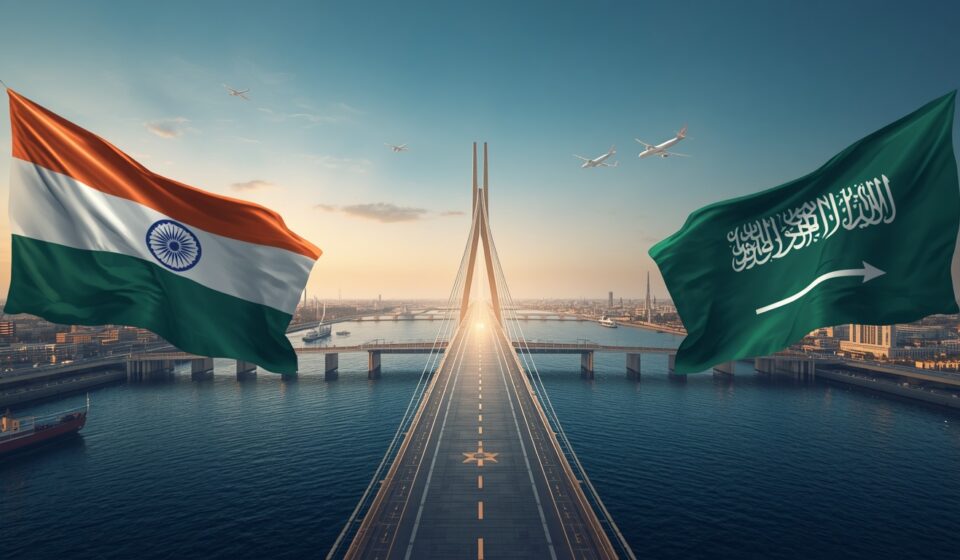
2. India-Saudi Arabia Strategic Partnership
Prompt: Create a high-end geopolitical editorial illustration showing India and Saudi Arabia as strategic partners. Feature the Indian and Saudi flags elegantly positioned on opposite sides, with a symbolic bridge connecting New Delhi and Riyadh across the Arabian Sea. Include subtle visual elements representing energy, trade, technology, investment, aviation and infrastructure. Modern diplomatic atmosphere, realistic architecture, sophisticated blue-and-gold visual mood, cinematic lighting, 16:9, no text.
3. The Journey from 1947 to 2047
Prompt: Create a conceptual timeline showing India’s transformation from Independence in 1947 toward the developed India vision of 2047. The left side should evoke 1947 with historical streets, freedom movement silhouettes and the first dawn of independence; the centre should show modern India with highways, digital infrastructure, manufacturing and cities; the right side should depict a futuristic India with clean energy, advanced technology, space exploration and smart cities. Editorial documentary style, cinematic realism, wide panoramic composition, 16:9, no text.
4. India’s Infrastructure Transformation
Prompt: Create a photorealistic aerial editorial image showing India’s modern infrastructure transformation: a major multi-lane national highway, high-speed railway tracks, modern trains, a large international airport and urban development integrated into one expansive landscape. Show India as a rapidly developing modern economy, realistic Indian environment, golden-hour lighting, high detail, international newspaper photography aesthetic, 16:9, no text.
5. India’s Digital Revolution
Prompt: Create a sophisticated visualization of India’s digital economy. Show a diverse group of Indian citizens using smartphones for instant digital payments, surrounded by subtle glowing digital networks, financial technology symbols, data streams and modern urban infrastructure. Blend physical India with an advanced digital ecosystem. Photorealistic editorial style, clean composition, premium technology magazine aesthetic, 16:9, no logos or text.
6. Artificial Intelligence and Semiconductor Ambition
Prompt: Create a futuristic but realistic editorial scene representing India’s investment in artificial intelligence, quantum computing and semiconductor technology. Show Indian engineers and researchers inside a cutting-edge semiconductor laboratory with advanced computer systems, microchips, quantum computing equipment and AI visualization interfaces. Indian technological environment, sophisticated realism, dramatic but professional lighting, 16:9, no text.
7. India’s Emerging Space Economy
Prompt: Create a cinematic image of India’s emerging private space industry. Show a modern Indian rocket launching from a coastal spaceport, surrounded by satellite technology, mission-control screens and a group of young Indian aerospace entrepreneurs and engineers. Convey the growth of a dynamic private space ecosystem. Photorealistic, inspirational, premium editorial photography, dramatic sky, 16:9, no text or logos.
8. India-Saudi Energy Partnership
Prompt: Create an editorial illustration representing the evolving India-Saudi energy partnership. Combine Saudi Arabian oil infrastructure and futuristic energy facilities with Indian solar farms, wind turbines, green hydrogen infrastructure and modern power grids. Include subtle Indian and Saudi flags in the composition. Emphasize the transition from traditional energy toward renewable and advanced energy cooperation. Photorealistic, sophisticated international magazine style, 16:9, no text.
9. Indian Community in Saudi Arabia
Prompt: Create a warm documentary-style image showing the Indian community living and working in Saudi Arabia. Depict Indian professionals, engineers, doctors, businesspeople, skilled workers and families in a modern Saudi Arabian urban setting. Include subtle elements of both Indian and Saudi cultures without stereotypes. The image should communicate friendship, contribution, dignity and human connection. Photorealistic, natural lighting, premium newspaper feature photography, 16:9, no text.
10. India-Saudi Business and Investment
Prompt: Create a premium international business editorial image showing Indian and Saudi business leaders meeting in a modern conference room in Riyadh. Behind them, subtle visual elements represent infrastructure, technology, renewable energy, logistics and investment. Include elegant Indian and Saudi flags, professional multicultural atmosphere, realistic corporate setting, cinematic lighting, 16:9, no text.
11. Peace, Trade and Maritime Security
Prompt: Create a sophisticated geopolitical image showing a major commercial cargo ship moving safely through the Arabian Sea toward the Gulf, with India and Saudi Arabia symbolically represented in the background. Include subtle maritime security and navigation elements, shipping containers, energy infrastructure and international trade routes. Convey stability, cooperation and uninterrupted global commerce. Photorealistic, cinematic editorial style, 16:9, no text.
12. India and Saudi Arabia — Future Together
Prompt: Create a visionary closing image for an international newspaper feature on India-Saudi relations. Show a futuristic but realistic skyline combining visual cues from New Delhi and Riyadh, connected by a luminous bridge across the Arabian Sea. Include advanced manufacturing, renewable energy, AI, space technology, logistics and cultural exchange as subtle background elements. Indian and Saudi flags should appear naturally and respectfully. Mood of optimism, partnership and shared prosperity, cinematic realism, golden sunrise, 16:9, no text, no watermark.